- By admin
Google Ads vs Meta Ads for Lead Generation: Which Should Your Business Use?
Google Ads vs Meta Ads for Lead Generation: Which Should Your Business Use?
Businesses investing in paid advertising often face the same question: Should we use Google Ads or Meta Ads for lead generation?
Both platforms can generate leads, but they usually reach potential customers in different contexts.
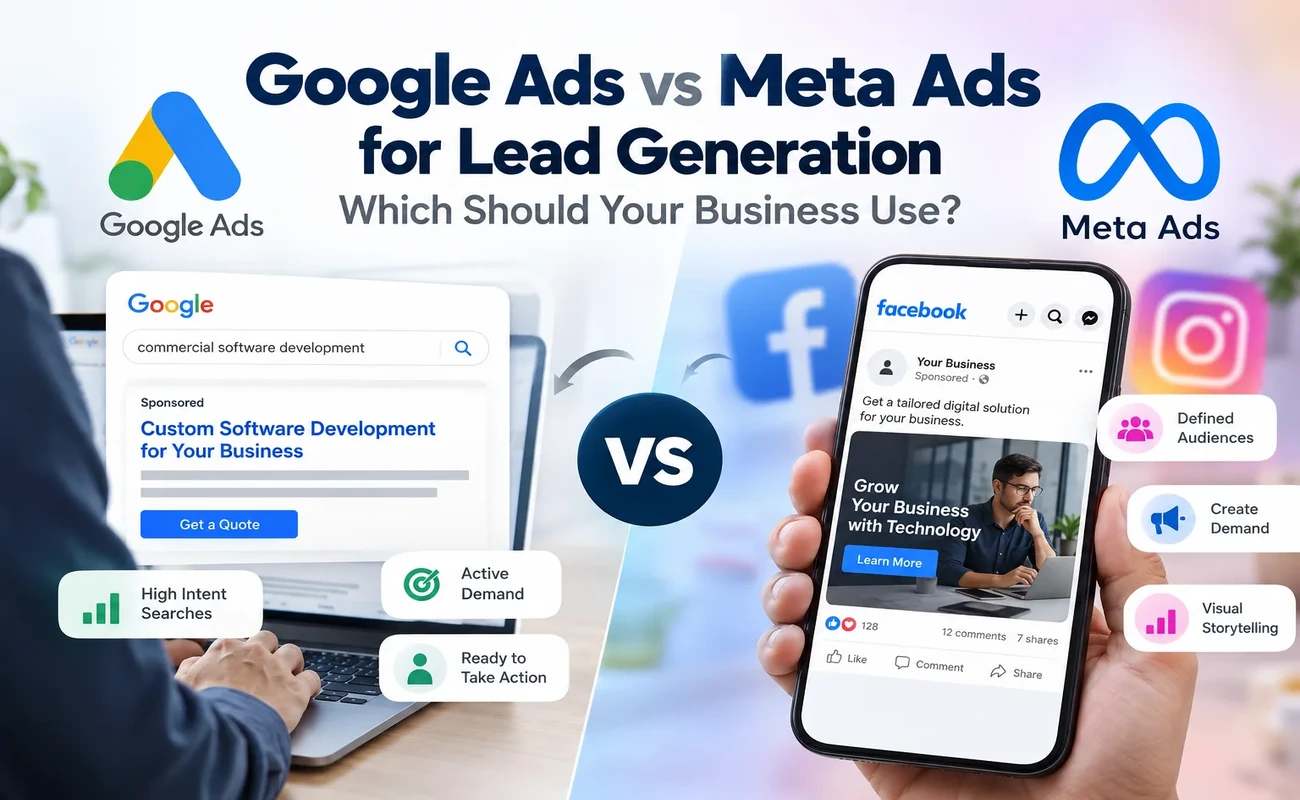
Google Search Ads can reach people while they are actively searching for a product, service, or solution. Meta Ads can help businesses reach audiences across Facebook and Instagram based on audience signals and previous interactions, including people who may not currently be searching for the offer.
That difference matters.
The better platform is not automatically the one with the lowest cost per click or the largest audience. The right choice depends on customer intent, target audience, offer, sales cycle, creative requirements, conversion path, budget, and—most importantly—the quality of the leads produced.
This guide explains the practical differences between Google Ads and Meta Ads and how to decide where each platform fits within a lead generation strategy.
Google Ads vs Meta Ads: The Key Difference
The simplest way to understand the difference is to look at how potential customers encounter the advertising.
With Google Search Ads, the interaction often begins with a search.
Someone might search for:
- commercial software development
- accountant near me
- industrial equipment supplier
- business consultant
- home renovation company
- logistics software
The advertiser can then appear in relevant search results.
Google states that Search campaigns can show ads to people actively searching online for the products and services a business provides. Google Help
Meta advertising works differently. Rather than depending primarily on a search query, advertisers can reach audiences using factors such as location, interests, existing customer relationships and other audience signals across Meta’s platforms. Meta also supports Custom Audiences for reaching existing audiences and Lookalike Audiences for finding people similar to existing users or customers. Facebook
This creates an important strategic distinction:
Google Search Ads often capture existing intent.
Meta Ads can help create, develop, or re-engage interest among relevant audiences.
Neither role is inherently better. They solve different marketing problems.
How Google Ads Works for Lead Generation
Google Ads includes several campaign types, but Search campaigns are particularly relevant when discussing high-intent lead generation.
Businesses can select keywords related to their products or services, and ads can become eligible to appear when people perform relevant searches.
Google explains that keywords help match ads with the terms people are searching for. Google Help
Where Google Search Ads Can Be Strong
Google Search Ads may be particularly useful when potential customers:
- Already understand their problem
- Know the type of solution they need
- Actively search for providers
- Use specific commercial search terms
- Need a local service
- Are comparing available options
Consider a person searching for an emergency repair service.
That person has already identified a need and is actively looking for a solution. The advertising challenge is therefore less about creating awareness and more about appearing for a relevant search with an appropriate offer and conversion path.
This is one reason Google Search can be effective for businesses with identifiable search demand.
Search Intent Still Needs Interpretation
Not every search represents the same level of buying intent.
Consider these hypothetical searches:
“What is ERP integration?”
and
“ERP integration company in Nashik”
Both relate to ERP integration, but the likely intent is different.
The first search appears primarily informational. The second suggests stronger commercial investigation.
Advertisers therefore need to consider the meaning behind searches rather than simply targeting every keyword related to the business.
Google Ads Is More Than Search
Google Ads should not be treated as synonymous with Search Ads.
Its advertising ecosystem includes campaign types and inventory across Search, Display, YouTube, Discover, Gmail, Maps and other Google surfaces. Performance Max, for example, can operate across multiple Google channels. Google Help
The correct Google campaign type depends on the objective, available data, creative assets, audience and customer journey.
Limitations of Google Ads for Lead Generation
High search intent does not guarantee a good lead.
A Google Ads campaign can still struggle when:
- Relevant search demand is limited
- Keywords are too broad or poorly aligned
- Competition makes acquisition expensive
- Advertisements do not match user intent
- The landing page is weak
- Conversion tracking is incomplete
- Forms create unnecessary friction
- Sales teams respond slowly
- Low-quality leads are treated as successful conversions
The platform can deliver a relevant visitor, but it cannot compensate for every weakness in the offer, website, sales process, or customer experience.
Search Volume Is Not the Same as Business Opportunity
A keyword receiving searches does not automatically make it commercially valuable.
Businesses should consider:
- Search intent
- Geographic relevance
- Competition
- Customer value
- Conversion potential
- Lead quality
- Sales close rate
This prevents keyword volume from becoming the only basis for campaign decisions.
How Meta Ads Works for Lead Generation
Meta Ads can help businesses reach audiences across platforms such as Facebook and Instagram.
Instead of waiting only for someone to perform a search, advertisers can introduce an offer to selected audiences.
This can be valuable when customers fit a recognizable profile but may not yet be actively searching for the product or service.
Where Meta Ads Can Be Strong
Meta Ads may be worth considering when:
- The product or service benefits from visual presentation
- The target audience can be meaningfully defined
- Demand needs to be created rather than simply captured
- The offer is understandable without extensive explanation
- The business has useful creative assets
- Previous website visitors or existing audiences can be re-engaged
- Lead-generation offers can be communicated clearly
Meta can therefore play an important role earlier in the customer journey.
Creative Has a Major Role
On search engines, users actively enter a query.
On social platforms, advertisements appear while people are consuming other content.
The advertisement therefore needs to earn attention.
Images, video, headlines, offers, positioning, and calls to action can significantly influence whether someone stops, engages, or takes the next step.
A campaign with technically accurate targeting can still underperform if the creative does not communicate why the audience should care.
Limitations of Meta Ads for Lead Generation
Meta Ads also has limitations.
A user who responds to an advertisement may not have the same immediate purchase intent as someone actively searching for a specific provider.
Businesses can therefore encounter situations where a campaign generates many leads but relatively few become meaningful sales opportunities.
Potential challenges include:
- Low-intent enquiries
- Weak creative
- Audience fatigue
- Broad targeting without a clear strategy
- Offers that attract curiosity rather than genuine prospects
- Insufficient lead qualification
- Slow sales follow-up
- Focusing on lead volume instead of lead quality
This is why cost per lead should not be the only success metric.
Google Ads vs Meta Ads: Side-by-Side Comparison
| Area | Google Search Ads | Meta Ads |
|---|---|---|
| Primary interaction | User searches for something | User encounters advertising while using social platforms |
| Typical strength | Capturing existing demand | Reaching, creating or re-engaging demand |
| Intent signal | Search query | Audience and behavioural/contextual signals |
| Creative requirement | Primarily ad copy for Search | Strong visual and message development often important |
| Audience approach | Keywords, search intent and additional targeting | Audience characteristics, signals and previous interactions |
| Remarketing | Available | Available |
| Lead generation | Website conversions and supported lead-form approaches | Website or platform-based lead generation depending on campaign setup |
| Best fit | Businesses with identifiable search demand | Businesses with definable audiences and compelling offers/creative |
| Main risk | Expensive or irrelevant search traffic | Lower-intent or poorly qualified leads |
| Key measurement | Qualified leads and downstream outcomes | Qualified leads and downstream outcomes |
This comparison is a framework rather than a universal rule.
Both advertising ecosystems continue to evolve, and individual campaign capabilities can extend beyond these simplified roles.
Which Platform Has Stronger Customer Intent?
For Google Search specifically, customer intent can be one of its strongest advantages.
Someone searching:
“commercial solar installer near me”
has taken an active step toward finding information or a provider.
That does not mean every searcher will become a customer, but the query itself provides useful evidence about what the person wants at that moment.
Google describes Search campaigns as a way to reach people actively searching for the products and services an advertiser offers. Google Help
Meta Ads often reaches customers in a different context.
The audience may match the characteristics of an ideal customer without currently searching for the solution.
That can make Meta useful for introducing an offer before explicit search demand appears.
The strategic question is therefore:
Do you need to capture existing demand, create demand, or do both?
How Targeting Differs Between Google Ads and Meta Ads
Targeting is another important difference.
Google Search Targeting
Search campaigns can use keywords to connect advertising with relevant searches.
Google explains that relevant keywords help advertisers reach customers when they are looking for what the business offers. Google Help
Campaign decisions can also involve factors such as:
- Geographic targeting
- Devices
- Scheduling
- Audience information
- Search terms
- Keyword matching
- Negative keywords
The search itself remains an important intent signal.
Meta Audience Targeting
Meta’s advertising environment has traditionally placed greater emphasis on audiences.
Depending on available campaign options and data, advertisers can work with factors such as location and audience characteristics, as well as Custom Audiences and Lookalike Audiences. Facebook
This can be valuable when a business understands the type of person it wants to reach even when that person is not actively searching.
Which Is Better for Local Businesses?
There is no universal winner for local businesses.
The answer depends on how customers discover the service.
Google Ads May Be a Strong Starting Point When:
Customers commonly search for the service when they need it.
Examples might include:
- Repair services
- Professional services
- Clinics
- Contractors
- Local suppliers
- Consultants
The ability to connect search intent with geographic relevance can make paid search particularly useful.
Meta Ads May Be Useful When:
The business needs to introduce an offer visually or generate interest among a local audience.
Examples could include:
- Events
- New businesses
- Selected consumer services
- Visual products
- Promotional offers
- Businesses with strong social creative
For some businesses, both platforms can contribute at different stages.
A local company in Nashik, for example, might use search advertising to capture people actively looking for its service while using paid social for awareness or remarketing.
The correct decision should follow customer behaviour rather than location keywords alone.
Which Is Better for B2B Lead Generation?
B2B lead generation often involves a longer and more complicated buying journey.
A business buyer may:
- Identify a problem
- Research possible approaches
- Search for providers
- Compare alternatives
- Discuss the requirement internally
- Request a proposal
- Obtain approval
- Make a purchasing decision
Google Search Ads can be valuable when buyers actively search for the relevant solution.
However, search demand may be limited for specialized or unfamiliar B2B products.
Meta Ads may help some businesses introduce ideas or retarget known audiences, but audience fit and lead quality require careful evaluation.
Neither platform should automatically be selected simply because the company operates in B2B.
The business needs to understand where its actual buyers discover and evaluate solutions.
Should You Use Google Ads and Meta Ads Together?
Yes, in some cases—but using both is not automatically better.
A multi-channel strategy makes sense when each platform has a defined role.
For example:
Meta Ads → Initial awareness → Website visit
Remarketing → Further consideration
Google Search → Later high-intent search → Enquiry
This journey will not apply to every customer, but it demonstrates how platforms can complement one another.
Another business may use Google Search as its primary acquisition channel and Meta only for remarketing.
A different company may generate most new demand through paid social and use Search to capture people who later search for the brand or category.
The objective is not to force both platforms into the strategy.
Each platform should have a reason for being there.
For a broader framework on selecting channels, read [How to Choose the Right Digital Marketing Channels for Your Business]
Lead Generation Does Not End With the Advertisement
An advertising campaign is only one part of the lead-generation system.
The complete journey may look like:
Ad → Click → Landing Page → Form or Call → Lead Qualification → Sales Follow-Up → Opportunity → Customer
Problems anywhere in that journey can affect the apparent performance of the advertising platform.
For example, a campaign might generate relevant enquiries, but if nobody responds for several days, the business may conclude that the advertising produced poor leads.
Similarly, a poorly designed form may generate fewer enquiries even when the advertising itself reaches an appropriate audience.
Website Forms vs Platform Lead Forms
Sending users to a website can provide more space to:
- Explain the offer
- Show supporting information
- Build trust
- Answer objections
- Present case studies or evidence
- Qualify visitors
- Provide different conversion options
However, the landing experience must be clear and usable.
Lead Forms
Advertising platforms can also provide lead-form functionality.
Google currently supports lead forms in eligible campaign configurations, including responsive Search ads, allowing users to submit information through a form associated with the advertisement. Google Help
The important question is not simply which form produces the most submissions.
It is:
Which approach produces leads that have a realistic chance of becoming customers?
Measure Lead Quality, Not Just Cost Per Lead
Imagine two campaigns:
Campaign A -
- 50 leads
- ₹500 cost per lead
- 2 qualified opportunities
Campaign B -
- 20 leads
- ₹900 cost per lead
- 8 qualified opportunities
Looking only at cost per lead makes Campaign A appear stronger.
Looking at commercial outcomes could lead to a very different conclusion.
This is why businesses should evaluate deeper funnel stages where possible.
Google Ads itself distinguishes between initial leads, qualified leads, and converted leads, allowing advertisers to measure activity deeper in the lead-to-sale journey.
Useful Lead Generation Metrics
Depending on the business, review:
- Lead volume
- Cost per lead
- Qualified lead rate
- Cost per qualified lead
- Appointment rate
- Proposal rate
- Sales conversion rate
- Customer acquisition cost
- Revenue from acquired customers
- Lead source
- Time to conversion
Not every business will have access to all of this data.
The principle is to measure as close to meaningful business outcomes as reasonably possible.
Your Landing Page Can Change the Result
Comparing Google Ads and Meta Ads without considering the landing experience can produce misleading conclusions.
A strong campaign can still fail if users reach a page that:
- Does not match the advertisement
- Loads poorly
- Is difficult to use on mobile
- Has an unclear offer
- Provides no evidence or trust signals
- Uses an unnecessarily complicated form
- Has a weak call to action
The landing page should continue the promise made in the advertisement.
Google also identifies landing-page experience as one of the factors involved in assessing keyword quality. Google Help
For deeper website architecture, technical SEO, content structure, and generative search work, Semitrique handles these requirements separately through its [Website SEO & GEO Generation](/website-seo-geo/) service.
Common Mistakes When Comparing Google Ads and Meta Ads
Comparing Only Cost Per Click
A cheaper click is not necessarily a better click.
One platform may have higher click costs while producing customers with greater commercial value.
Comparing Only Cost Per Lead
Lead volume without lead quality can create misleading campaign conclusions.
Using the Same Creative on Both Platforms
Search and social environments are different.
Campaign messaging and creative should reflect how users encounter advertising on each platform.
Comparing Only Cost Per Lead
Lead volume without lead quality can create misleading campaign conclusions.
Using the Same Creative on Both Platforms
Search and social environments are different.
Campaign messaging and creative should reflect how users encounter advertising on each platform.
Ignoring Search Intent
Google Search campaigns require more than selecting keywords with high search volume.
Businesses should consider what the search suggests about the user’s actual need.
Targeting Broad Audiences Without a Clear Offer
Large audiences do not automatically produce better results.
Audience selection, offer relevance, creative, and conversion path need to work together.
Failing to Track Conversions
Without appropriate measurement, businesses may optimize campaigns around clicks or traffic rather than meaningful actions.
Google identifies conversion tracking as an important foundation for measuring lead-generation campaigns.
Treating Every Lead as Equal
A spam submission, irrelevant enquiry, student research request, qualified prospect, and sales-ready opportunity should not all be treated as having identical business value.
How to Decide Which Platform to Start With
Use the following questions before allocating budget.
1. Are Customers Already Searching for What You Sell?
If there is meaningful commercial search demand, Google Search may deserve investigation.
If customers do not know the solution exists, relying exclusively on search may limit reach.
2. Can You Clearly Define the Audience?
If you understand the audience but they are not necessarily searching, paid social may have a role.
3. Is the Offer Visually Compelling?
Products or services that can be communicated effectively through images or video may have more opportunities in social environments.
4. How Long Is the Buying Cycle?
Longer buying cycles may require multiple interactions rather than expecting the first click to generate a sale.
5. What Happens After the Click?
Make sure the website, landing page, form, phone process, and sales follow-up can support the campaign.
6. Can You Measure Lead Quality?
Without lead-quality information, optimization may focus on the easiest form submission instead of the most valuable customer.
7. What Budget Can Be Tested Responsibly?
Avoid spreading a limited budget across multiple platforms simply to maintain a presence everywhere.
Start where the strongest business case exists and expand when evidence supports it
Google Ads vs Meta Ads: Which Is Better?
Neither platform is universally better for lead generation.
Google Search Ads may be a stronger fit when:
- Customers actively search for the solution
- Commercial search intent can be identified
- The business wants to capture existing demand
- Search geography is important
- There is a clear conversion path
Meta Ads may be a stronger fit when:
- The audience can be meaningfully defined
- The business needs to create or develop demand
- Visual creative can communicate the offer effectively
- Social discovery is relevant to the buying journey
- Remarketing has a useful role
Using both may make sense when:
- They perform different jobs
- The customer journey involves multiple touchpoints
- The business has sufficient budget and resources
- Conversion and lead-quality measurement are available
The decision should be based on customer behaviour and business economics—not on which advertising platform is currently more popular.
Frequently Asked Questions
Is Google Ads or Meta Ads Better for Lead Generation?
Neither is better for every business. Google Search Ads can be useful for capturing existing search demand, while Meta Ads can help businesses reach and develop interest among defined audiences. The appropriate platform depends on the audience, offer, customer journey, budget, and conversion process.
Is Google Ads Better for High-Intent Leads?
Google Search can provide a strong intent signal because users actively search for products, services, and solutions. However, a search does not guarantee that the resulting lead will be qualified or become a customer.
Can Meta Ads Generate Quality Leads?
Yes, Meta Ads can generate useful leads when audience selection, creative, offer, qualification, conversion experience, and follow-up work together. Businesses should evaluate downstream lead quality rather than lead volume alone.
Which Platform Is Better for Small Businesses?
It depends on how customers find the business. A local service with strong search demand may prioritize Google Search, while a business with a visual or discovery-led offer may find Meta useful. Budget and operational capacity also matter.
Should I Run Google Ads and Meta Ads at the Same Time?
Only when each platform has a clear role and the business has enough resources to manage and measure both properly. Using more platforms does not automatically improve campaign performance.
Which Is Cheaper: Google Ads or Meta Ads?
There is no reliable universal answer. Advertising costs vary by industry, audience, location, competition, campaign setup, creative, objective, and other factors. Cost per click or cost per lead should also be considered alongside lead quality and customer value.
How Long Should I Run Ads Before Comparing Results?
There is no fixed period that applies to every campaign. The decision should consider conversion volume, sales cycle, budget, data quality, campaign changes, and whether enough meaningful activity has occurred to support a useful comparison.
Do Google Ads or Meta Ads Guarantee Leads?
No. Advertising platforms can provide access to audiences and advertising inventory, but results also depend on the offer, competition, targeting, creative, budget, website experience, sales process, market conditions, and other factors.
Choose the Platform Based on the Customer Journey
The better advertising platform depends on how customers discover, evaluate, and act on your offer. Google Search can be useful when people are already looking for a solution, while Meta Ads can help introduce an offer, build interest, and re-engage relevant audiences earlier in the journey.
Instead of asking which platform is universally better, define the role each channel should play. Some businesses may need only one platform, while others can use both at different stages. The strongest choice is based on customer intent, audience fit, offer clarity, conversion path, budget, and lead quality.
Ready to Turn Paid Traffic Into Better Leads?
Choose the right advertising platform based on customer intent, audience behaviour, conversion paths, and lead quality—not just clicks or impressions.
Semitrique helps businesses plan and improve paid campaigns across Google Ads and Meta Ads with clearer targeting, stronger campaign structure, and measurable performance goals.