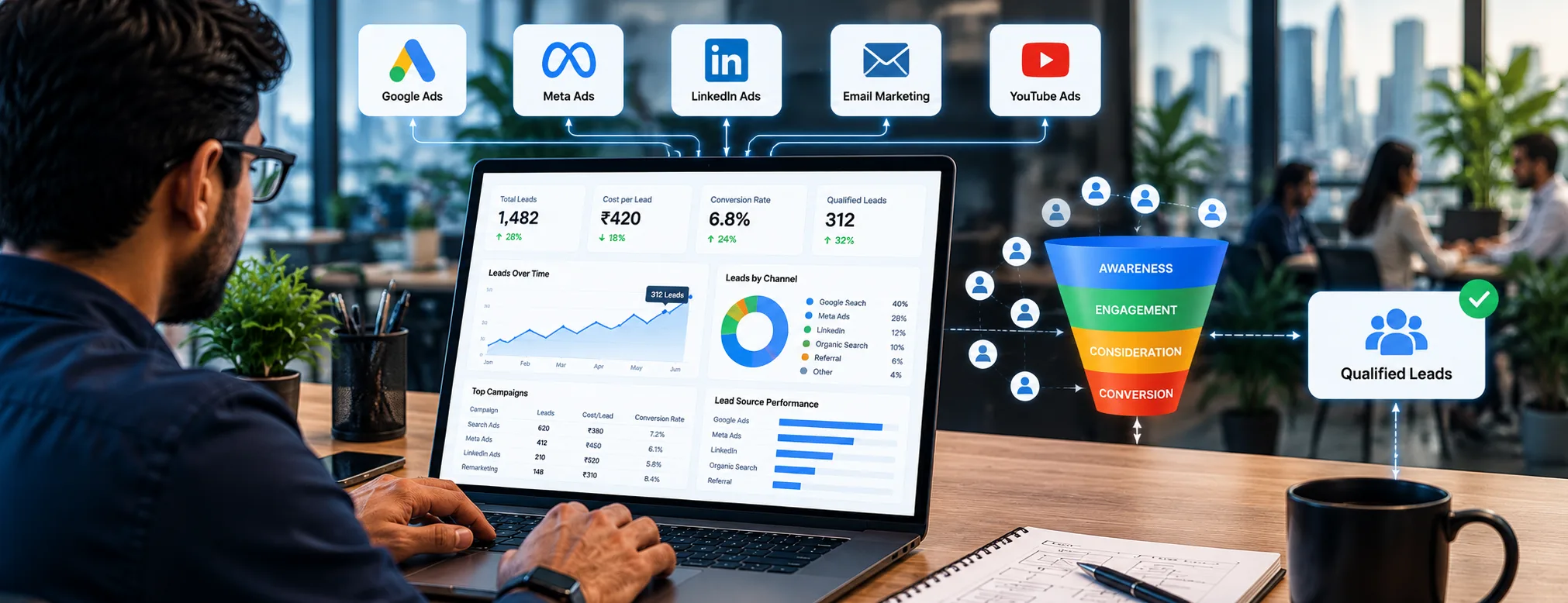
Lead Generation Campaign Strategy
Lead generation requires more than running advertisements and collecting form submissions. A strong campaign needs a defined audience, a relevant offer, the right channel for the customer’s level of intent, a clear conversion path, reliable tracking, and a practical way to evaluate whether the resulting leads are meaningful to the business.
Semitrique approaches lead generation as a coordinated digital marketing process. Planning begins by understanding the business objective, target market, customer profile, offer, buying journey, available budget, existing digital presence, and the action a potential customer should take after interacting with a campaign.
The appropriate campaign structure can then be developed across relevant channels such as Google Ads, Meta Ads, LinkedIn, email, content, remarketing, or other suitable platforms. Not every business requires every channel. Channel selection should reflect where the audience can realistically be reached and what role each platform needs to play within the customer journey.
Business Objective → Audience Definition → Offer & Message → Channel Selection → Campaign Setup → Landing / Conversion Path → Lead Capture → Qualification → Measurement → Optimization
| Campaign Area | Strategic Focus |
|---|---|
| Business Objective | Define what the campaign is expected to support and which actions matter to the business |
| Audience Targeting | Identify relevant customer segments using location, intent, interests, demographics, business characteristics, or other appropriate signals |
| Offer & Messaging | Communicate a clear reason for the intended audience to consider the product, service, or next action |
| Channel Selection | Choose paid search, paid social, content, email, remarketing, or other channels according to audience and intent |
| Campaign Structure | Organize campaigns, audiences, advertisements, objectives, budgets, and targeting around defined roles |
| Conversion Path | Create a clear journey from advertisement or content to landing page, form, call, enquiry, or another meaningful action |
| Lead Capture | Collect only the information needed to support the next stage of the business process |
| Tracking & Analytics | Measure relevant campaign actions using available platform, website, and analytics data |
| Lead Quality | Evaluate whether enquiries are relevant to the intended audience and business requirement |
| Remarketing | Re-engage appropriate audiences who have previously interacted with relevant digital touchpoints |
| Performance Review | Compare campaign activity with conversions, lead quality, costs, and other meaningful indicators |
| Optimization | Refine targeting, messaging, budgets, creatives, channels, and conversion paths using reliable performance signals |
Define the Lead Before Building the Campaign
Not every form submission, phone call, or message has the same business value. Before launching a campaign, the business should define what it considers a relevant lead.
Depending on the requirement, qualification criteria might include service requirement, location, company type, decision-making role, project scope, budget range, purchase intent, or another appropriate business factor.
This creates a clearer measurement path:
Campaign Interaction → Enquiry → Relevant Lead → Qualified Lead → Sales Opportunity → Business Outcome
The stages will differ between businesses, but separating them can prevent campaign performance from being judged only by the total number of enquiries.
Audience & Market Definition
Effective targeting begins with understanding who the campaign needs to reach.
The target market may be local, regional, national, B2B, B2C, industry-specific, or based on a particular customer requirement. Audience planning can consider demographics, location, interests, search behaviour, professional characteristics, existing customer information, or platform-specific targeting options where appropriate.
The goal is not simply to create the largest possible audience. It is to create a sufficiently relevant audience for the campaign objective.
Customer Need → Audience Segment → Relevant Message → Appropriate Channel → Conversion Opportunity
Channel Selection
Different digital channels serve different roles.
Google Search Ads can be useful when potential customers are actively searching for a relevant solution. Meta Ads can support audience discovery, visual communication, demand generation, and remarketing. LinkedIn may be relevant for certain professional or B2B audiences. Email can support follow-up or nurturing when appropriate permission and contact data are available.
A campaign may therefore use one channel or a coordinated combination.
High Search Intent → Paid Search → Relevant Landing Page → Enquiry
Audience Discovery → Paid Social → Interest / Engagement → Landing Page → Lead
Previous Visitor → Remarketing → Return Visit → Conversion
The correct structure depends on the audience, offer, budget, customer journey, and available channel opportunities.
Offer & Campaign Message
Advertising cannot compensate indefinitely for an unclear offer.
Campaign messaging should help the intended audience understand what is being offered, why it may be relevant, and what action they can take next. The message should remain consistent enough between the advertisement and destination so users are not presented with a different proposition after clicking.
Audience Need → Relevant Offer → Clear Message → Supporting Information → CTA
Campaign claims should also remain accurate and supportable. Lead generation should not rely on exaggerated promises simply to increase clicks.
Conversion Path
The campaign does not end when someone clicks an advertisement.
The destination experience can significantly affect whether relevant visitors continue toward an enquiry. Depending on the campaign, the conversion path may involve a dedicated landing page, service page, contact form, phone call, messaging action, platform lead form, booking process, or another defined action.
A useful conversion path should make the next step clear:
Ad / Content → Relevant Destination → Clear Information → Trust Signals → CTA → Form / Contact Action → Confirmation
Unnecessary steps, confusing forms, weak mobile usability, or a mismatch between advertisement and landing-page content can create friction.
Lead Forms & Data Collection
Lead forms should collect information that has a practical purpose.
A simple campaign may only require name, email, phone number, and requirement. A more complex B2B process may need company information, project type, service requirement, or another qualification field.
Adding too many fields can create unnecessary friction, while collecting too little information may make qualification difficult.
The appropriate balance depends on the business process and the value of the enquiry.
Tracking & Conversion Measurement
Campaign measurement should connect marketing activity with meaningful user actions wherever technically possible.
Relevant tracking may include:
Ad Impression → Click → Landing-Page Visit → Conversion Action → Lead → Qualified Lead
Campaign platforms and analytics tools can provide useful information, but tracking is not always complete. Consent choices, browser restrictions, device changes, offline conversations, technical configuration, and platform attribution methods can affect reported results.
For that reason, campaign decisions should use the most reliable combination of available data rather than treating a single platform report as a complete representation of the customer journey.
Lead Quality Matters More Than Lead Volume Alone
A campaign generating many enquiries is not necessarily more effective if most enquiries are irrelevant.
Where reliable business feedback is available, performance should be reviewed beyond the initial conversion.
Useful indicators can include:
- Qualified leads
- Cost per lead
- Cost per qualified lead
- Conversion rate
- Relevant enquiry rate
- Sales opportunities
- Customer acquisition information where available
- Revenue-related signals where attribution is sufficiently reliable
The appropriate KPIs depend on the campaign objective and the data the business can accurately provide.
Remarketing & Follow-Up
Not every relevant prospect converts during the first interaction.
Remarketing can help reconnect with appropriate audiences who previously visited a relevant page, interacted with campaign content, or completed another eligible action.
A simplified journey may be:
Initial Visit → No Conversion → Eligible Remarketing Audience → Relevant Follow-Up Message → Return Visit → Conversion
Remarketing should be configured in accordance with applicable platform requirements, consent choices, privacy considerations, and available audience data.
Campaign Optimization
Optimization should be based on meaningful evidence rather than constant changes made simply to create activity.
Performance reviews may identify opportunities to refine:
Audience → Search Terms → Targeting → Creative → Message → Offer → Landing Page → CTA → Budget → Conversion Path
For example, high click volume with weak lead quality may indicate a targeting or messaging issue. Relevant traffic with poor conversion may require closer review of the offer or destination experience. Strong lead volume with weak business relevance may require changes to qualification or audience strategy.
The appropriate response depends on what the data actually indicates.
Campaign Learning Loop
Lead generation should create information that improves future decisions.
Launch → Collect Data → Review Performance → Evaluate Lead Quality → Identify Issues → Make Focused Changes → Measure Again
This creates a structured improvement cycle instead of repeatedly rebuilding campaigns without understanding what changed.
Built Around Business Outcomes, Not Surface-Level Metrics
Semitrique’s Lead Generation Campaign Strategy focuses on connecting audience targeting, channel selection, campaign messaging, conversion paths, tracking, lead quality, and performance analysis.
The objective is not simply to generate more impressions, clicks, or form submissions. It is to create a clearer path between marketing activity and relevant business enquiries, while using available evidence to improve campaign decisions over time.
No advertising platform or campaign structure can guarantee a specific number of leads, customers, revenue, or return on advertising spend. Results depend on factors including market demand, competition, offer strength, budget, audience fit, sales process, website experience, and other business conditions.