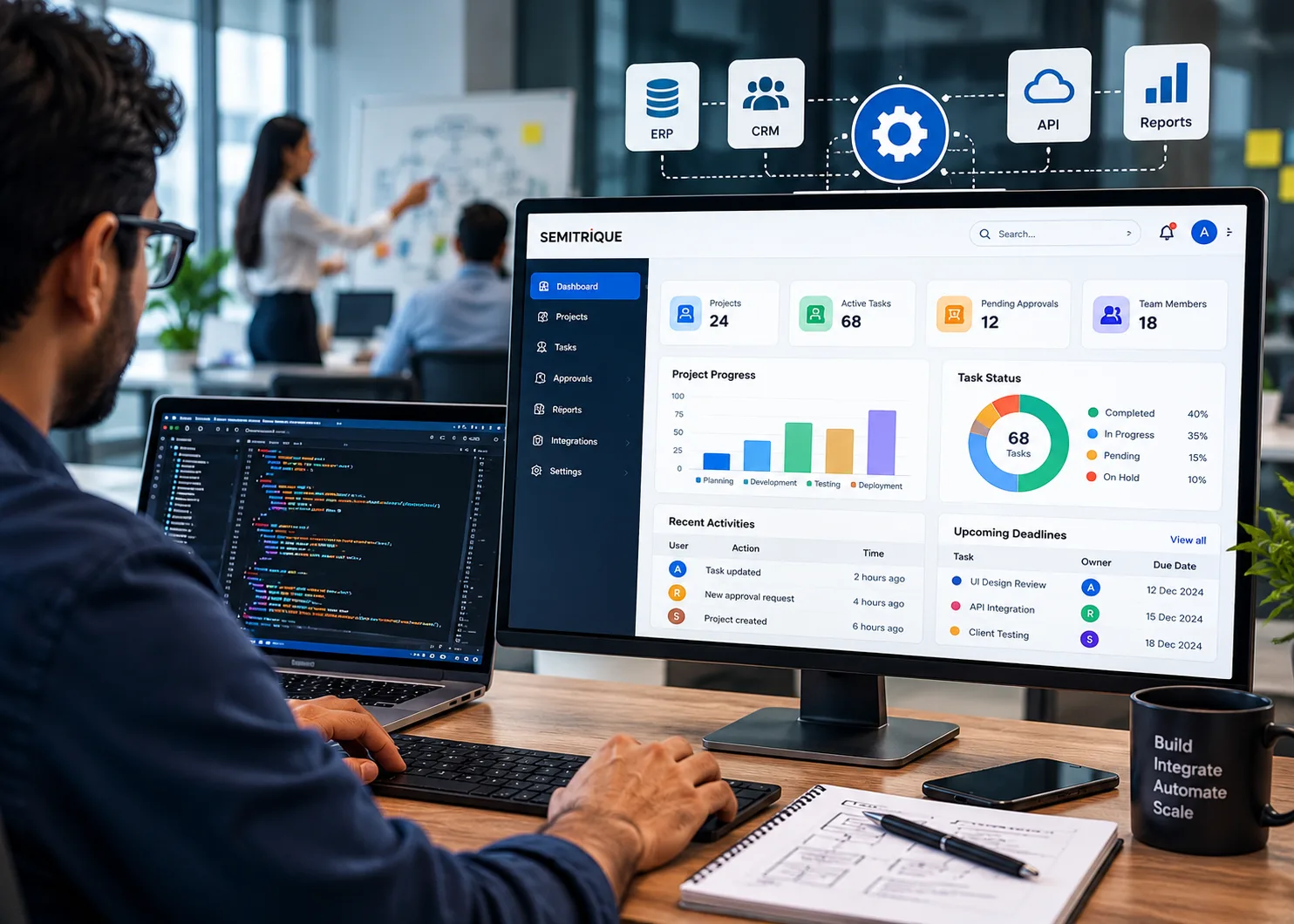
Business Website Development
A business website should do more than present company information. It should provide a clear digital environment where visitors can understand the business, explore relevant services or solutions, find important information, and move naturally toward the next action.
Semitrique approaches business website development around the actual requirement of the organization. Before development begins, the focus is placed on understanding the business, target users, website objectives, required functionality, content structure, conversion paths, existing digital assets, integrations, and technical environment. This helps define what the website needs to accomplish instead of starting with a predefined template or technology.
The website structure is then planned around clear page purposes and user journeys. Navigation, content hierarchy, page relationships, calls to action, forms, and important information are organized so users can move through the website without unnecessary complexity. Where search visibility is relevant, the structure can also provide a stronger foundation for crawlability, internal linking, page intent, metadata, structured information, and future SEO & GEO work.
Development decisions depend on the requirement. A straightforward corporate website may need a relatively simple architecture, while another business may require dynamic content, custom functionality, APIs, third-party integrations, forms, dashboards, content management capabilities, or connections with existing business systems. The technology should support the requirement rather than determine it.
Responsive behaviour is considered across desktop, tablet, and mobile environments. Attention is also given to practical factors such as performance, accessibility, security considerations, maintainability, content administration, and future expansion within the agreed project scope.
Business Requirement → User & Content Planning → Website Architecture → UI & Responsive Experience → Development & Integration → Testing & Launch → Review & Evolution
| Area | Development Focus |
|---|---|
| Business Requirements | Website objectives, users, functionality, operational needs and project scope |
| Information Architecture | Page hierarchy, navigation, content relationships and user journeys |
| Responsive Experience | Practical usability across desktop, tablet and mobile devices |
| Website Development | Front-end, back-end, CMS, dynamic functionality and required business logic |
| Forms & Integrations | Enquiry forms, APIs, third-party platforms and supported business-system connections |
| Search Foundations | Crawlable structure, page purpose, internal linking and technically accessible content |
| Performance | Efficient page delivery, media handling and appropriate technical optimization |
| Testing & Quality | Functionality, responsive behaviour, forms, links, integrations and browser checks |
| Maintainability | Practical content management and an architecture that can accommodate future requirements |
Requirement-Led Development
The appropriate website is defined by what the business actually needs. Semitrique can structure the development approach differently for informational websites, corporate websites, service-led websites, dynamic platforms, and websites requiring custom functionality or integrations.
Clear User Journeys
Important pages should have a defined purpose. Visitors should be able to understand where they are, what information is available, what the business offers, and what action they can take next.
Responsive by Design
Layouts and interactions are planned to work across different screen sizes rather than treating mobile responsiveness as an afterthought.
Connected Where Required
Where the requirement calls for it, a website can connect with supported APIs, CRM or ERP environments, analytics platforms, forms, marketing tools, or other business applications. The exact integration approach depends on the systems and technical access available.
Built for Ongoing Use
Launch is not the only consideration. Content administration, maintainability, future functionality, technical dependencies, and the ability to evolve the website should be considered during planning and development.
Structured for Digital Growth
A well-planned website can provide the foundation for future SEO & GEO and digital marketing activity without turning website development itself into a duplicate SEO or marketing service. Development establishes the technical and structural environment; dedicated search and marketing work can build on that foundation according to its own objectives.