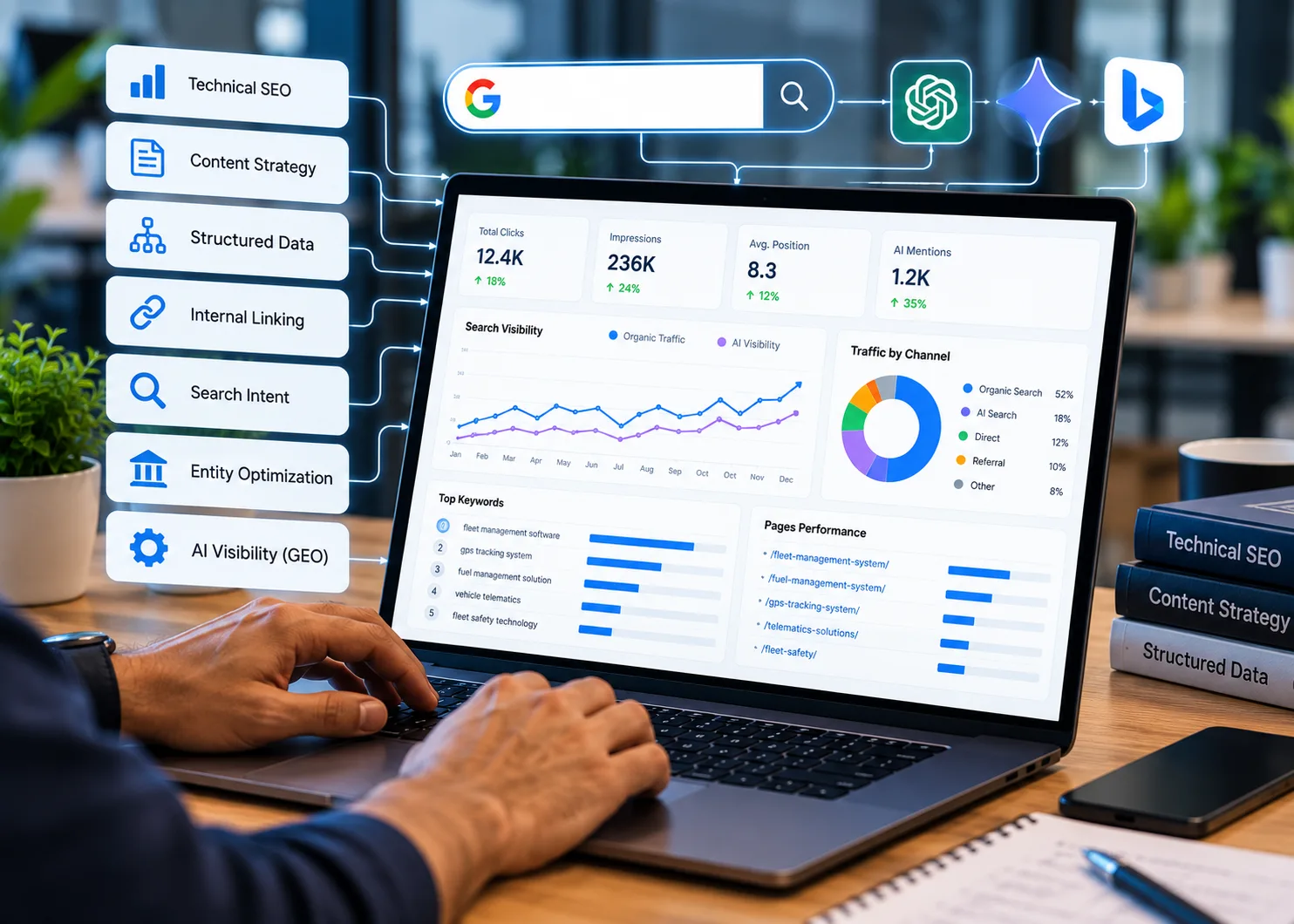
Search & AI Visibility Framework
Search visibility is no longer limited to traditional rankings alone. Businesses now need websites that are technically accessible, clearly structured, easy to understand, and consistent enough to support visibility across search engines and AI-driven discovery environments.
Semitrique approaches Search & AI Visibility as a structured website framework rather than a shortcut or isolated optimization task. The work begins by understanding the business, services, audience, important topics, existing website structure, technical environment, and the search intent behind key pages.
The framework can combine technical SEO foundations, content structure, internal linking, entity clarity, structured information, and generative search considerations so that important website content is easier for users, search engines, and AI systems to interpret.
Business Context → Search Intent Mapping → Technical SEO Review → Content & Page Structure → Internal Relationships → Entity & Information Clarity → Structured Data → AI Search Readiness → Monitoring & Improvement
| Area | Framework Focus |
|---|---|
| Search Intent | Define what users are trying to accomplish and align important pages with distinct search purposes |
| Technical SEO | Review crawlability, indexability, canonicals, redirects, sitemaps, robots directives, and rendering considerations |
| Website Architecture | Organize pages, URLs, hierarchy, navigation, and topic relationships around clear business and user needs |
| Content Structure | Use clear headings, page purpose, supporting information, and useful depth without unnecessary keyword repetition |
| Internal Linking | Connect related services, resources, studies, and supporting content through meaningful page relationships |
| Entity Clarity | Keep business names, services, locations, terminology, and relationships consistent across important pages |
| Structured Data | Apply relevant schema markup where appropriate to help clarify page and business information |
| GEO / AI Readiness | Structure important information so it is easier to interpret across generative and AI-driven search environments |
| Content Quality | Support pages with original, useful, factual, and context-rich information aligned with user needs |
| Monitoring | Review indexing, visibility, content performance, search queries, and changes in website structure over time |
Search Intent Mapping
Each important page should have a clear purpose. Multiple pages should not be created simply to repeat similar keywords or target nearly identical search intent.
The process begins by identifying what the user is trying to find, compare, understand, or accomplish.
User Need → Search Intent → Relevant Page → Supporting Content → Internal Links → Conversion / Next Action
This helps reduce unnecessary overlap between pages while creating a clearer information path for both users and search systems.
Technical Search Foundations
Search visibility depends on whether important content can be discovered and processed correctly.
Technical considerations can include crawlability, indexing, canonical URLs, redirect handling, XML sitemaps, robots directives, JavaScript rendering, mobile usability, and performance-related implementation.
These foundations do not guarantee rankings, but they help reduce technical barriers that can prevent important pages from being understood or indexed correctly.
Content & Information Architecture
Strong search performance depends on more than adding target phrases to a page.
Important pages should explain their subject clearly, use logical headings, provide useful supporting information, and maintain clear relationships with related content.
A typical structure might look like:
Primary Service Page → Supporting Article → Related Study → FAQ / Supporting Resource → Relevant Internal Link
This creates a stronger topical relationship without forcing multiple pages to compete for the same query.
Internal Linking
Internal links help users move between related information and help search systems understand how pages connect.
Useful internal linking can connect:
- Services to supporting articles
- Articles to relevant service pages
- Studies to related capabilities
- Related resources to one another
- Location or business information to relevant commercial pages
Anchor text should be descriptive and natural rather than repetitive or keyword-stuffed.
Entity & Business Information Clarity
AI-driven and modern search systems increasingly depend on clear context.
Important business information should remain consistent across the website, including company name, service descriptions, location details, terminology, and relationships between services or solutions.
For Semitrique, this means keeping the core capability structure clear and consistent across the Home, Services, Our Work, Blog, and Contact pages.
Structured Data
Structured data can help search engines interpret certain types of information more clearly when relevant markup is available and implemented correctly.
Depending on the page, structured data may support organization details, articles, breadcrumbs, FAQs, or other eligible content types.
Structured data should reflect visible page content and should not be used to create information that is not actually present on the website.
GEO & AI Search Readiness
Generative Engine Optimization does not replace SEO.
It builds on the same core requirements: clear information, strong technical foundations, useful content, consistent business context, and logical page relationships.
AI search readiness can include:
- Direct answers to important user questions
- Consistent service terminology
- Clear descriptions of products or services
- Strong content hierarchy
- Accurate business and location information
- Original subject-matter information
- Clear supporting evidence where claims are made
- Well-connected related pages
- Structured information where appropriate
The goal is to make important website information easier to understand and connect—not to guarantee inclusion in AI-generated responses.
Avoiding Keyword Cannibalization
A strong framework should reduce competition between the website’s own pages.
Before creating new content, the existing site should be reviewed to determine whether another page already serves the same intent.
A simple decision flow is:
New Topic → Existing Relevant Page? → Yes → Improve / Expand Existing Page
New Topic → No Existing Page → Create Distinct Page → Link to Related Content
This helps keep the website focused and prevents multiple pages from targeting the same user need without a clear reason.
People-First Content
Content should primarily help the intended audience understand a topic, evaluate an option, solve a problem, or take the next relevant step.
Keyword research can help identify how people search, but the final content should not be written as a collection of repeated phrases.
Useful pages should provide:
- Clear answers
- Relevant context
- Accurate information
- Practical examples
- Logical structure
- Helpful internal links
- Clear next actions
Monitoring & Continuous Improvement
Search visibility changes over time as websites evolve, competitors publish new content, user behaviour shifts, and search systems change.
Ongoing review can include indexing status, search queries, landing-page performance, internal links, content overlap, technical issues, and opportunities to improve important pages.
The purpose is not constant unnecessary editing. It is to identify meaningful issues and improve the website when evidence supports the change.
Built for Search Understanding, Not Search Manipulation
Semitrique’s Search & AI Visibility Framework is designed to strengthen the website’s technical foundation, content clarity, page relationships, and business context.
The objective is to create a website that is easier for people to navigate, easier for search engines to understand, and better prepared for generative search environments—without relying on keyword stuffing, duplicated pages, unsupported claims, or promises of guaranteed rankings or AI citations.